Release
What no longer needs to be carried.
The world in one breath
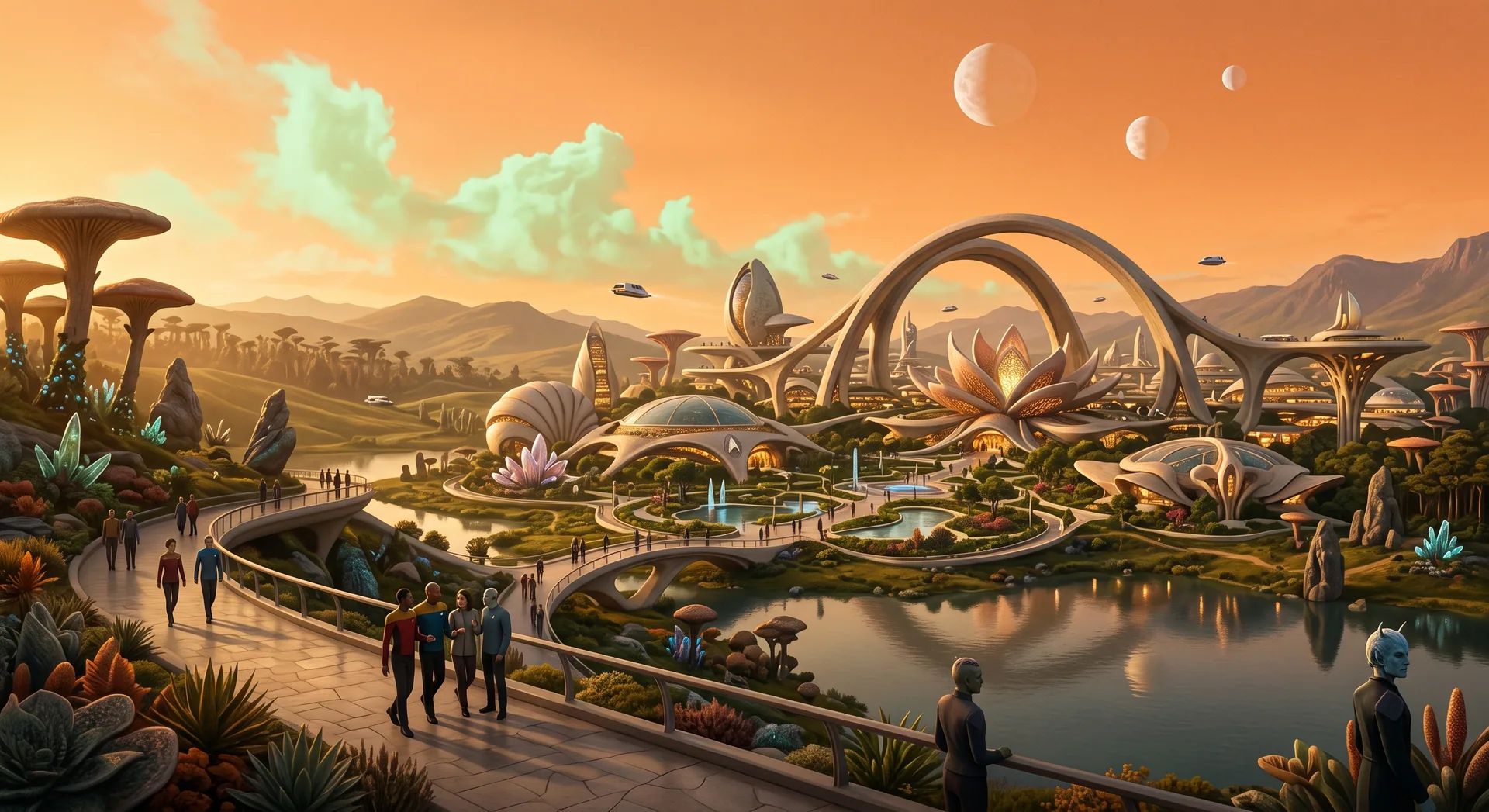
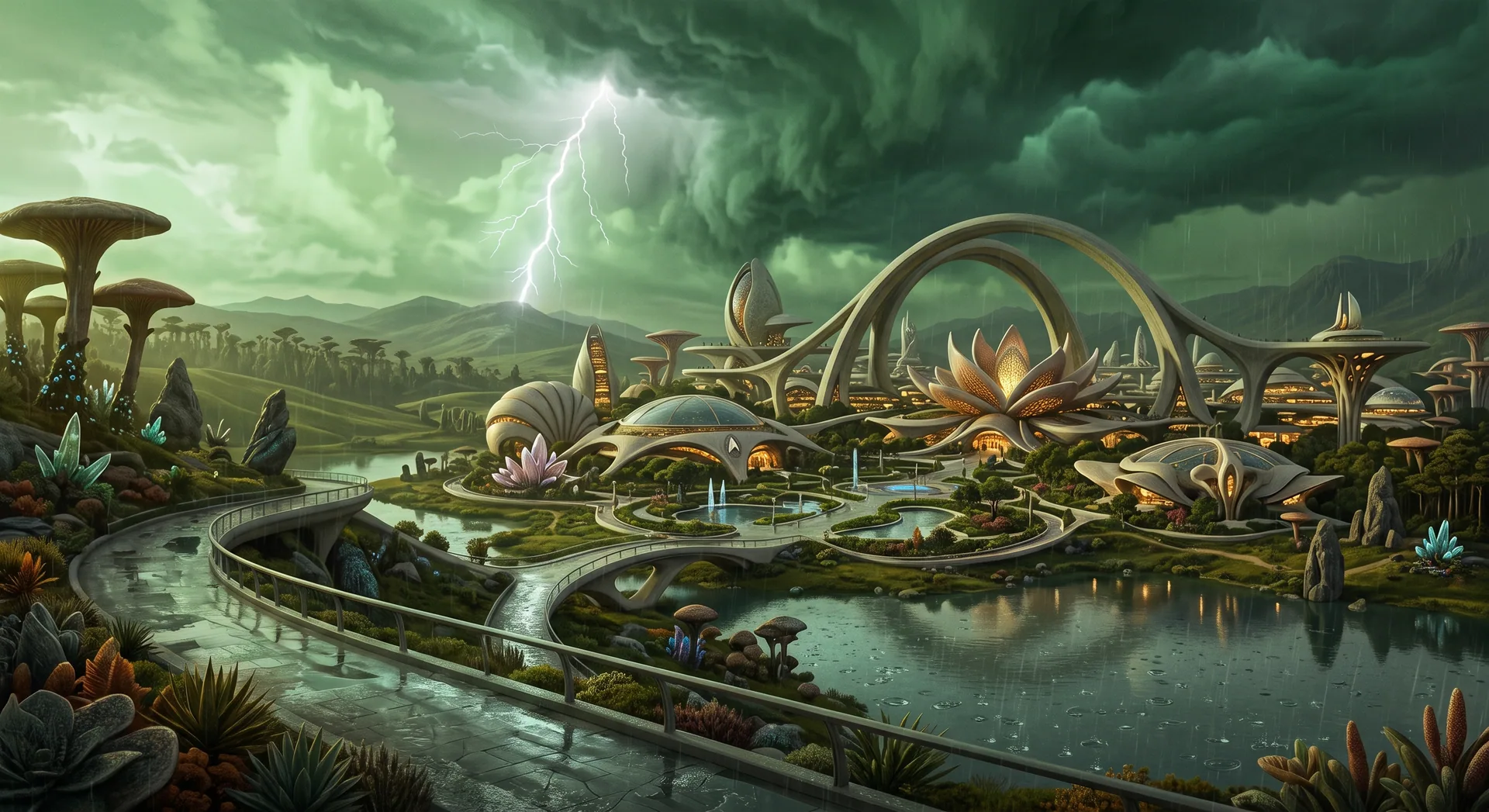
Maia IV orbits within the stable Maia trinary system—a low-gravity world, slightly larger than Earth, with tangerine skies, pale celadon clouds, native photosynthetic aeroplankton, and fungal forests built to an extraordinary scale.
Nearly the entire permanent population lives at Maia Station, whose civic and medical districts hold 1.0 g. Beyond its cultivated perimeter, much of the planet remains protected for ecological study, archaeology, and xenoanthropology.
The Queens are felt through light.
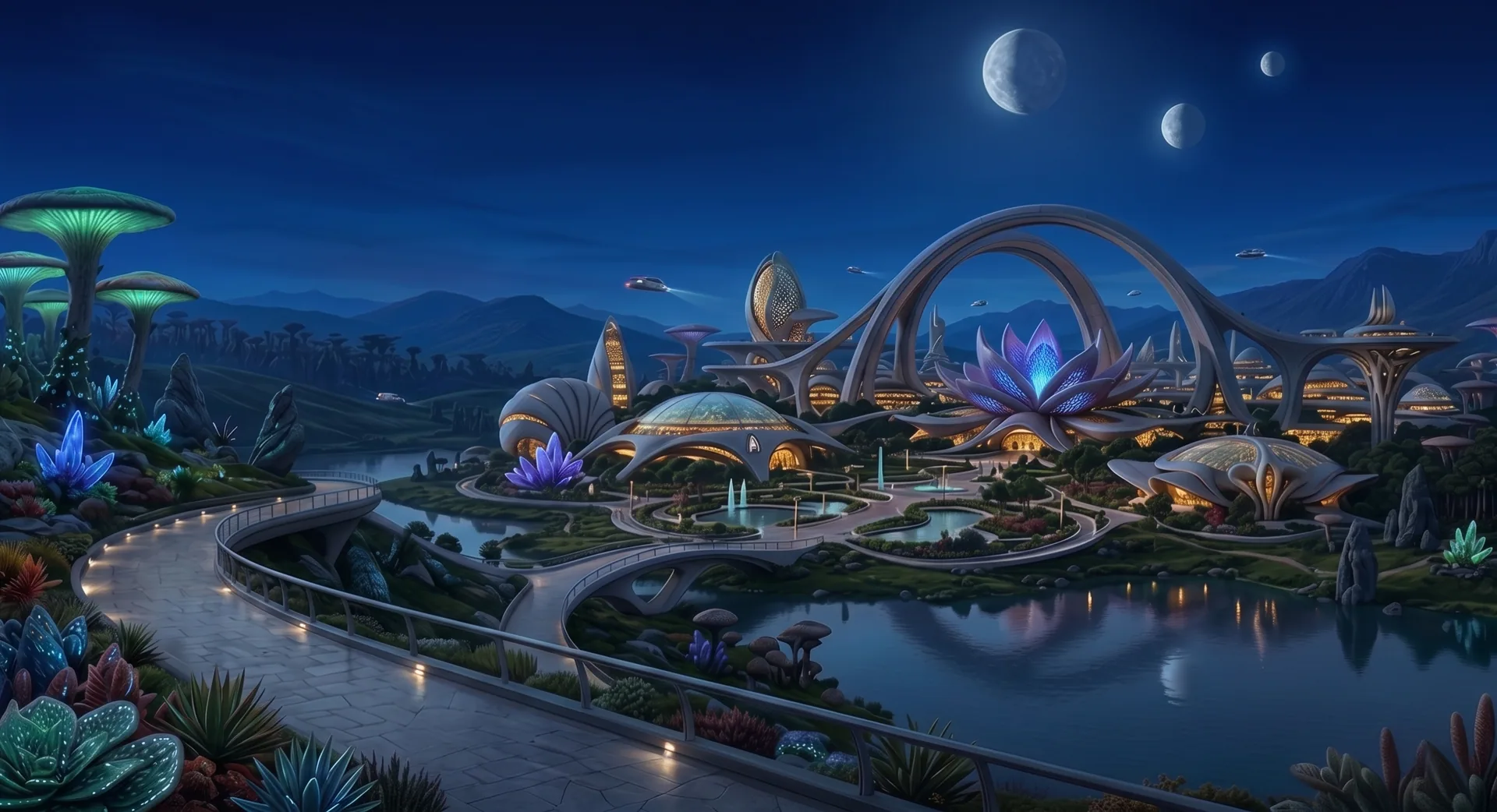
The Fates are seen in darkness.
The world before arrival
Long before Humanity traveled between stars, Maia IV was home to an advanced civilization organized around a base-3 understanding of mathematics, time, ecology, and meaning.
The civilization vanished in deep antiquity. Its inscriptions, durable materials, foundations, and protected sites survived in enough detail to reveal a culture shaped by three stars, three moons, and recurring triadic systems.
The Fates are not Federation inventions. Their associations with beginning, measure, and ending descend from the world’s surviving record. Their familiar names are Federation Standard renderings of far older ideas.
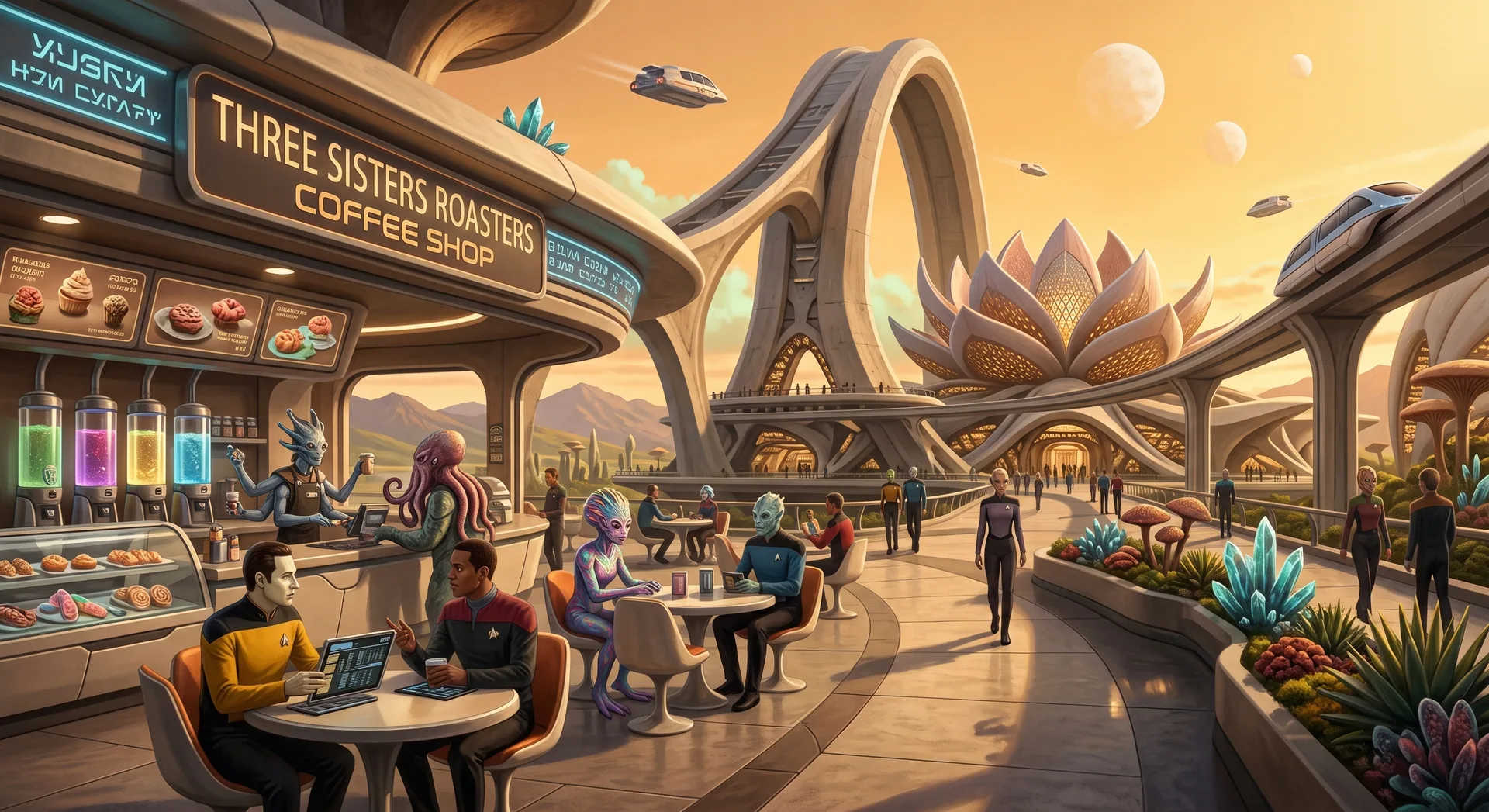
Daily life unfolds beneath the Fates, where transit, research, neighborhood life, and a morning at Three Sisters Roasters overlap.
Ordinary life
It is the planet’s only major population center: residents, clinicians, schools, research teams, cafés, visitors, and people who arrived for six weeks and stayed twelve years.
Beyond the station
Maglev lines leave Maia Station for agricultural belts, research preserves, and the planet’s native-gravity wilderness.
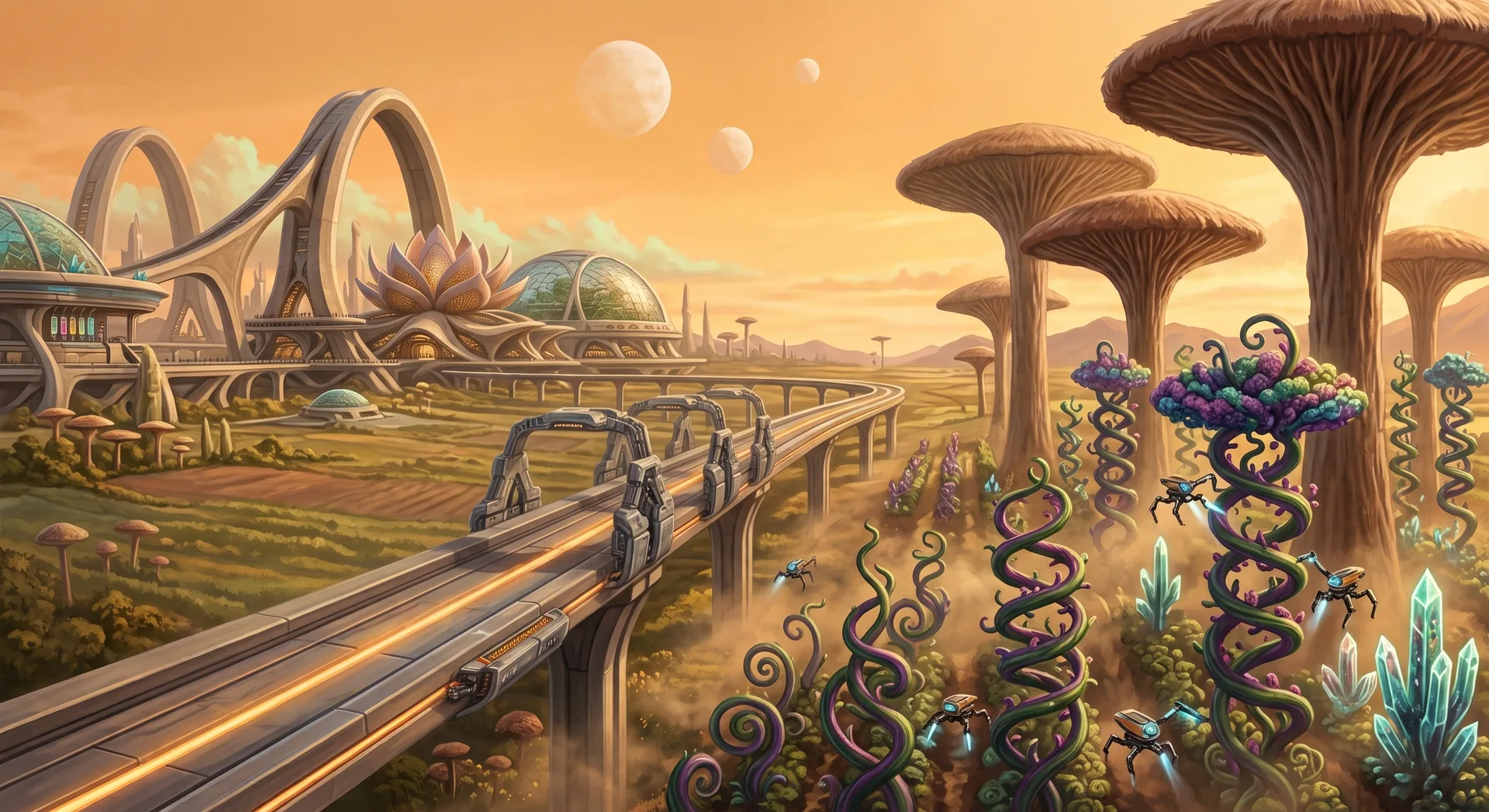
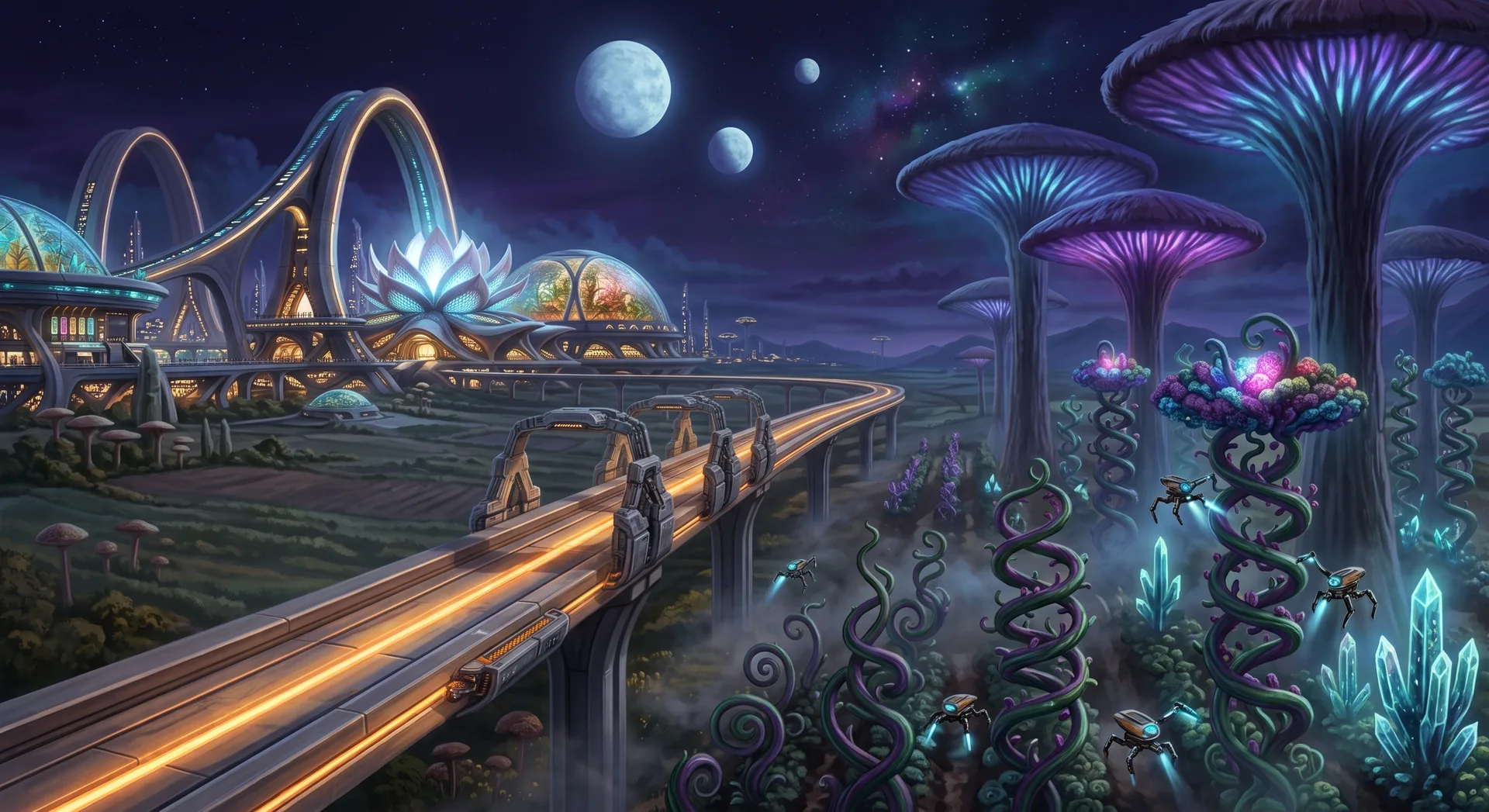
The outer maglev crosses the boundary between the station’s controlled gravity and the giant fungal preserves beyond.
The architecture of self
What no longer needs to be carried.
What becomes visible when urgency quiets.
What a person chooses to become next.
Planetary context
The Queens rule the system.
The Fates circle the world.
Three natural satellites preserve the oldest names in the planetary record.
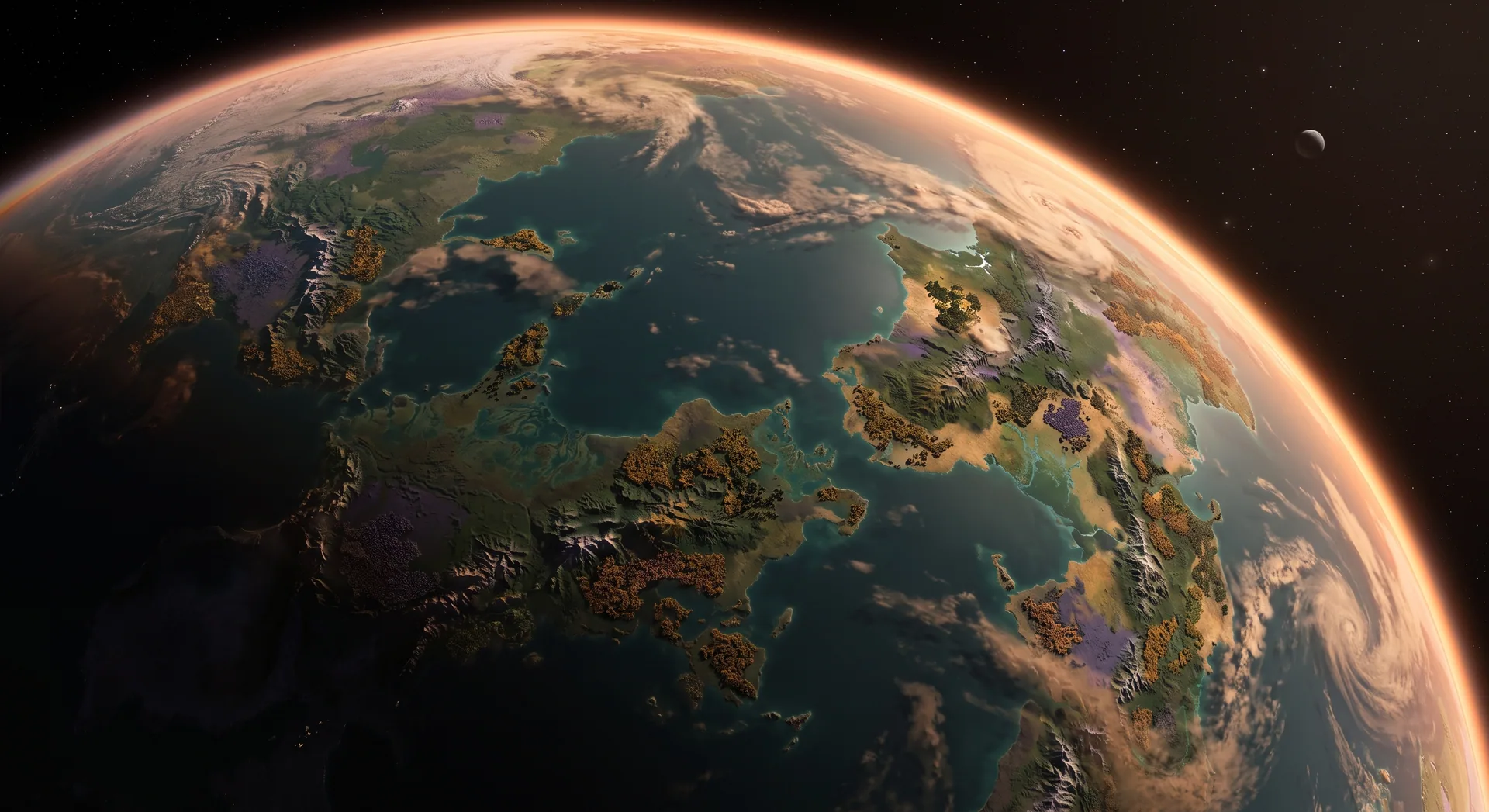
A 0.8-g Class-M world in the Maia trinary system.
01 · Stellar system
Maia A and Maia B form a close central binary. Maia I, II, and III occupy the inner system before the inhabited Maia IV. Maia C is the distant third star; Maia V through Maia XII occupy the much larger outer system beyond the red dwarf.
Starbase 419, in orbit of Maia X, is the Federation’s principal outer-system hub, coordinating navigation, scientific missions, resource operations, freight transfer, and Starfleet logistics while keeping most heavy industrial traffic away from Maia IV.
Maia A and Maia B form the close central binary. Maia I through Maia IV follow inner circumbinary paths; Maia C is the distant third light on a much larger eccentric stellar path whose closest approach remains well beyond Maia IV. Maia V through Maia XII are catalogued in the Outer System Register.
Clotho, Lachesis, and Atropos occupy three distinct, well-separated orbital tracks around Maia IV.
The dominant member of the close central binary and the principal source of usable light and heat.
Gravitationally bound to Maia A in the tight central stellar pair.
The distant red dwarf beyond Maia IV and the system’s third sustained light source.
02 · Planetary profile
Native photosynthetic aeroplankton inhabit the upper atmosphere and cloud-forming layers. Illuminated primarily by Maia A, their pigments—and the size and concentration of the biological aerosols around them—alter how daylight scatters through the atmosphere, contributing to the tangerine sky and pale celadon clouds.
As Maia IV cools after sunset, the aeroplankton descend from the upper cloud-forming layers into denser air and enter a less active state. With fewer pigment-bearing organisms suspended at altitude—and no direct stellar illumination to scatter—the celadon cast fades through twilight, revealing a deep cobalt sky and the three Fates above.
03 · Natural history
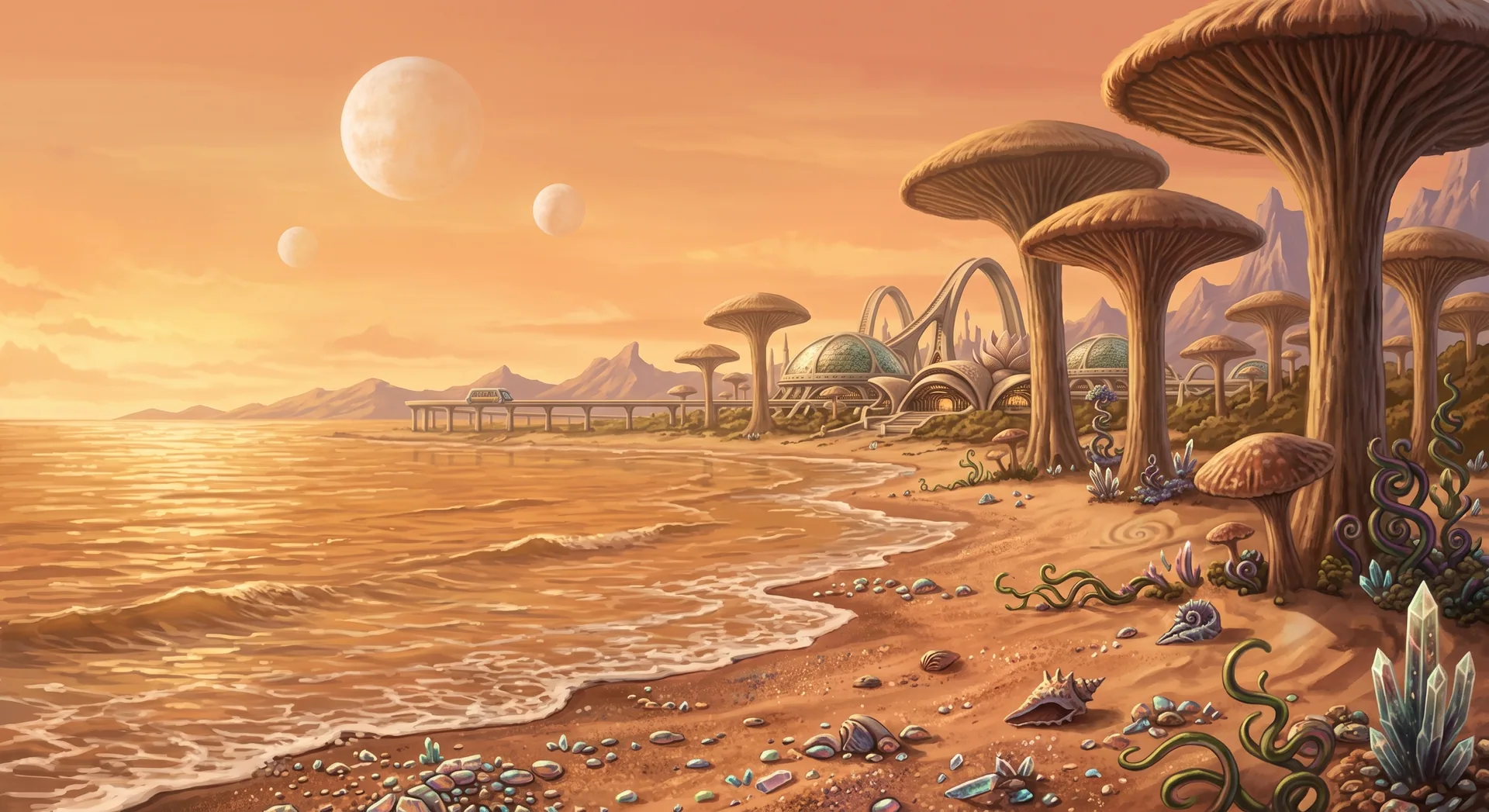
A protected littoral where shallow seas, native fungal megaflora, and the distant research network meet.
04 · Cultural record
Long before Humanity developed interstellar travel, Maia IV supported an advanced indigenous civilization. It had already been extinct for an immense span of time when Federation surveyors arrived.
The civilization organized mathematics, measurement, architecture, astronomy, language, and symbolic thought around base three. The Queens, the Fates, and their associated symbolism all originate in this culture.
Xenoanthropology on Maia IV draws from an unusually durable material record, allowing scholars to study a people separated from Humanity by both origin and deep time.
The cause of its disappearance remains unknown.
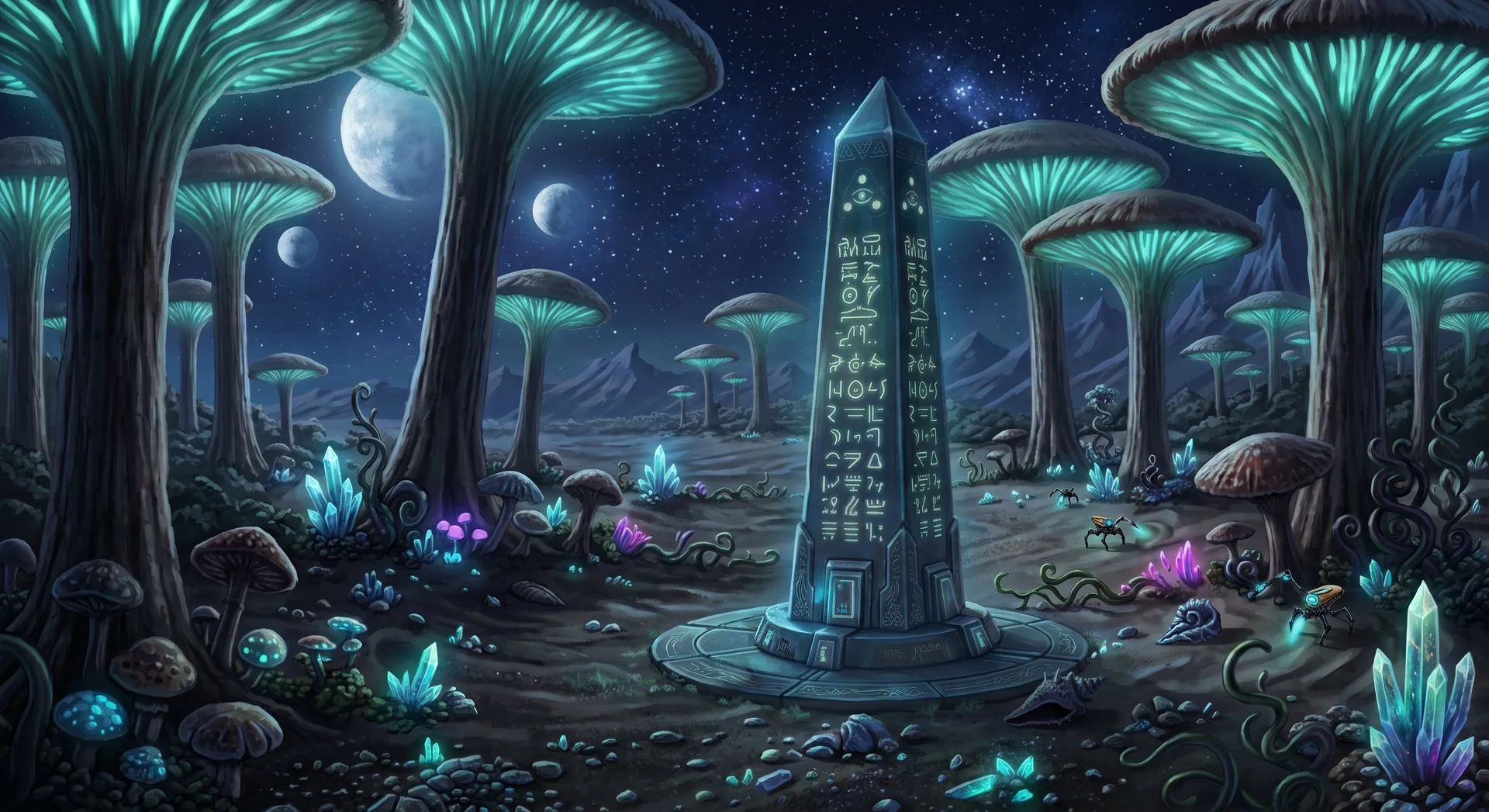
Autonomous survey units document a monumental inscription field beneath Clotho, Lachesis, and Atropos.
05 · Protected status
Most of Maia IV is protected. Permanent settlement outside designated zones is prohibited.
Sixty-three agricultural and archaeological field stations support cultivation, conservation, and xenoanthropology within limited research and transit corridors.
06 · Human presence
Maia Station helps people adapt between different gravitational environments and serves patients recovering from injury, illness, bodily transition, and extended residence on low- or high-gravity worlds.
Medical cohorts, visiting specialists, research teams, and other temporary residents typically raise the population present on Maia IV to between 265,000 and 280,000.
Over time, the station also became associated with reflection, reinvention, and personal growth.
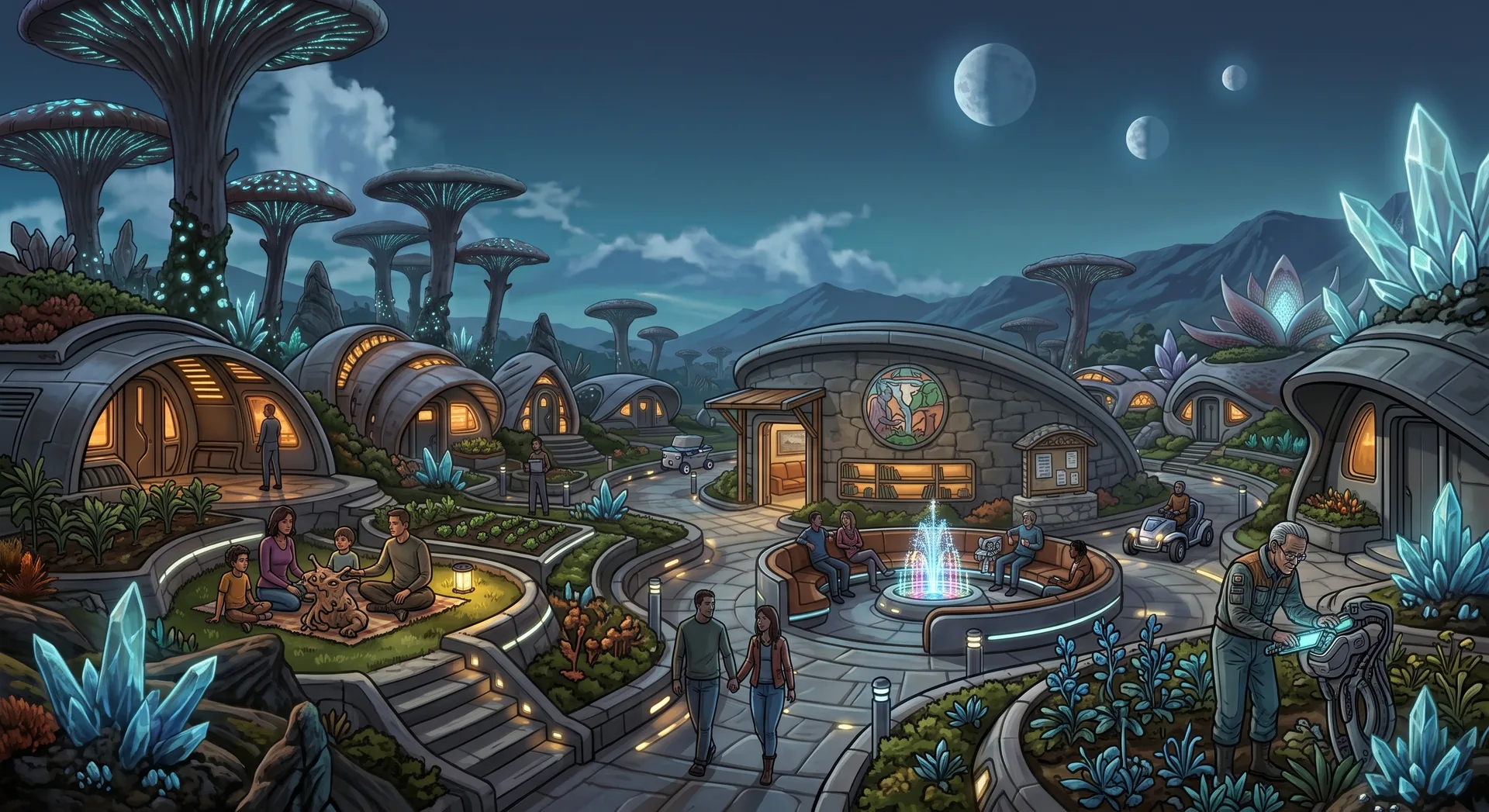
Homes gather around a neighborhood commons combining a local transporter node, open-air library, gardens, and shared civic space beneath the Fates.
07 · Outer-system operations · Maia X orbit
The Federation’s principal operations hub in the Maia system—and the place where most of the traffic Maia IV was never meant to carry is coordinated.
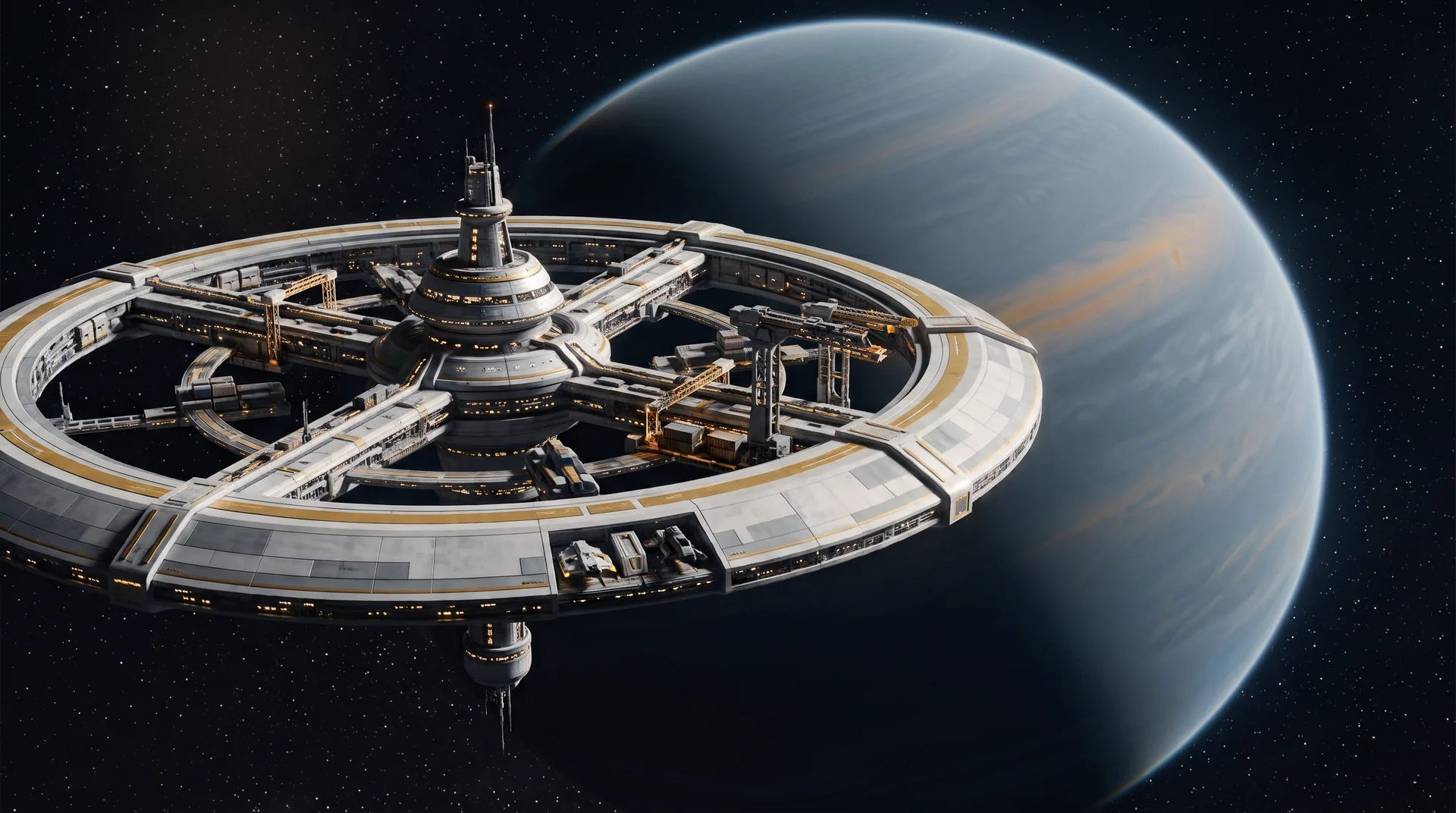
Operations-gold markings distinguish the station responsible for navigation, research support, freight transfer, resource activity, and Starfleet logistics across the outer Maia system.
Starbase 419 concentrates outer-system activity at Maia X, allowing Maia IV to remain a place of settlement and study rather than the system’s industrial port.
Starbase 419, or The Four-Nineteen, is a Presidio-class deep-space operations starbase: a standardized Federation ring-and-spine design whose interchangeable cargo, refinery, repair, laboratory, and habitat modules can be configured for distant systems without designing a new station for each assignment.
Traffic bound for Maia V through Maia XII is coordinated here. Three operations-marked California-class vessels—an assignment informally known as the Station Triad—are permanently based at Starbase 419, supporting survey teams, navigation infrastructure, freight movements, field repairs, and the less celebrated work required to keep a twelve-planet system functioning.
08 · Material network
Starbase 419 does not operate every extraction site directly. It coordinates a distributed network of atmospheric skimmers, lunar installations, asteroid processors, and civilian freight vessels, then assays, refines, stores, and routes their output.
Deuterium, helium-3, and hydrogen are collected from the Maia system’s three outer gas giants, including Maia X, for fusion systems, starship operations, and regional energy reserves.
Uninhabited moons supply water ice, ammonia, methane, and other industrial volatiles. Dilithium-bearing formations are worked selectively under separate Federation licenses and continuous geological review.
Duranium, tritanium, iron, nickel, silicates, and carbonaceous material support station maintenance, ship repair, fabrication, and infrastructure projects throughout the sector.
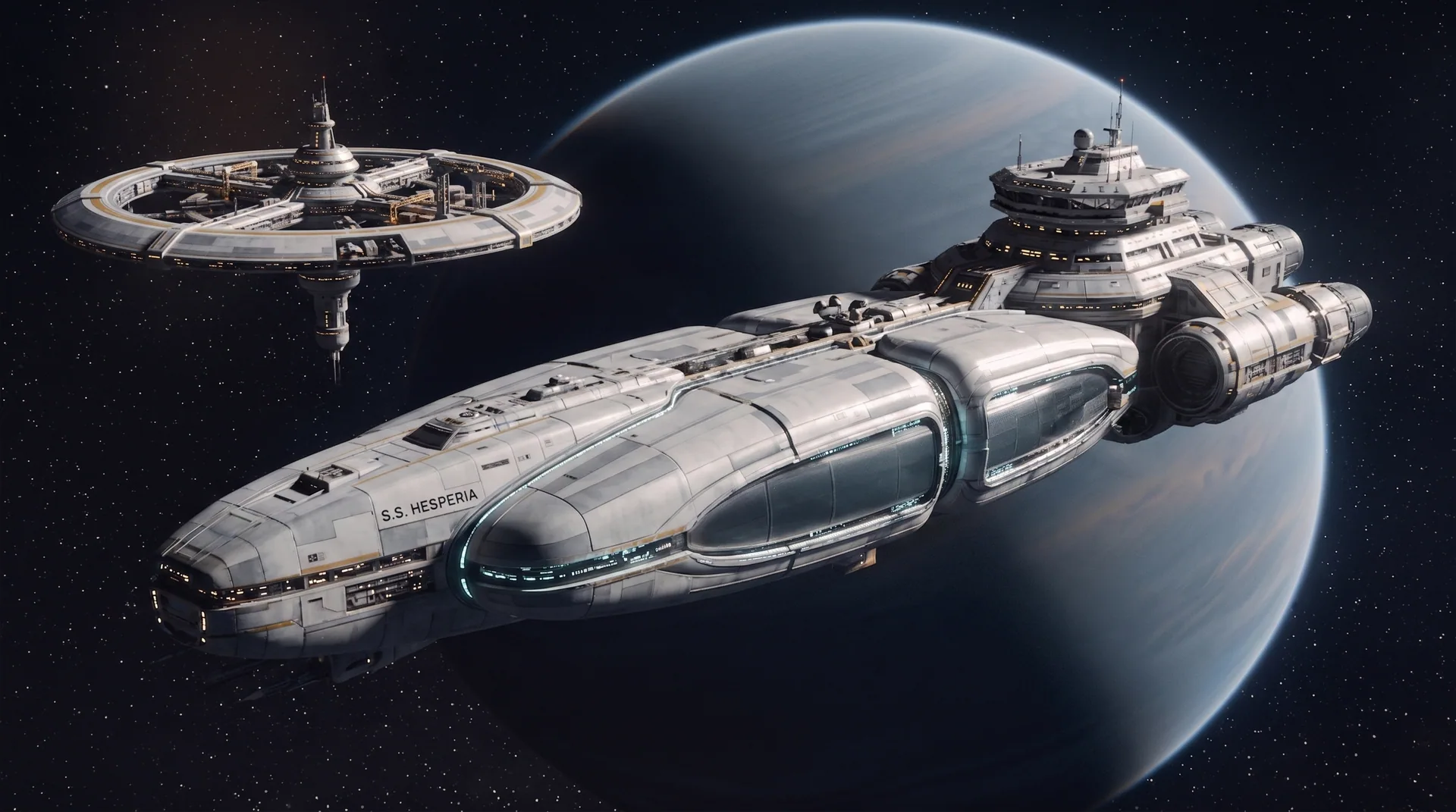
An in-system modular bulk carrier arrives at the Four-Nineteen with refined fuels, industrial volatiles, and construction feedstocks from the outer Maia system.
Maia IV is excluded from the extraction network. Operations elsewhere in the system are suspended wherever biological activity, archaeological material, or an unregistered ecological relationship is detected.
Queen’s Triad is not where people go to escape their lives.
It is where they learn how to inhabit them.
Return to the light